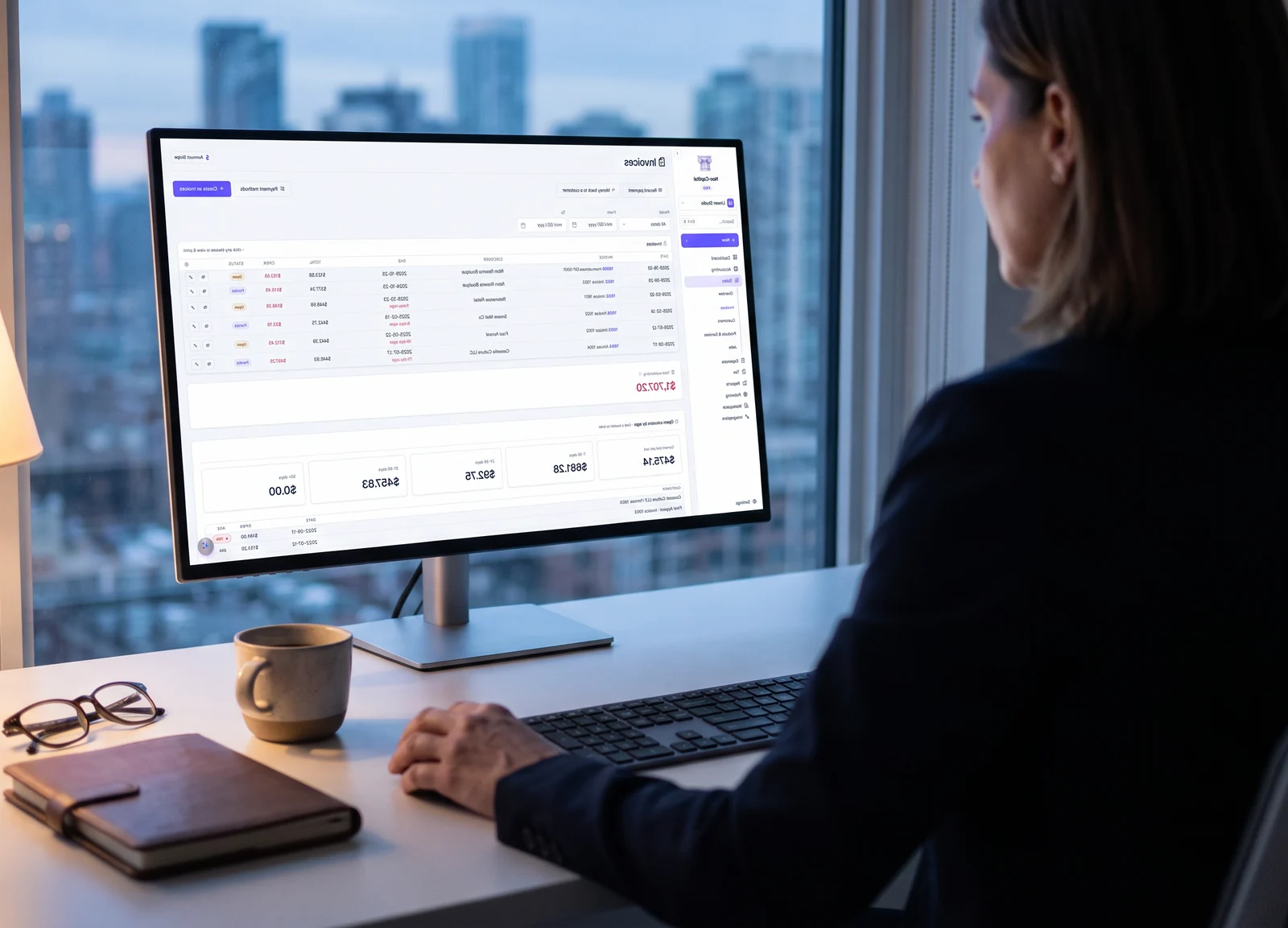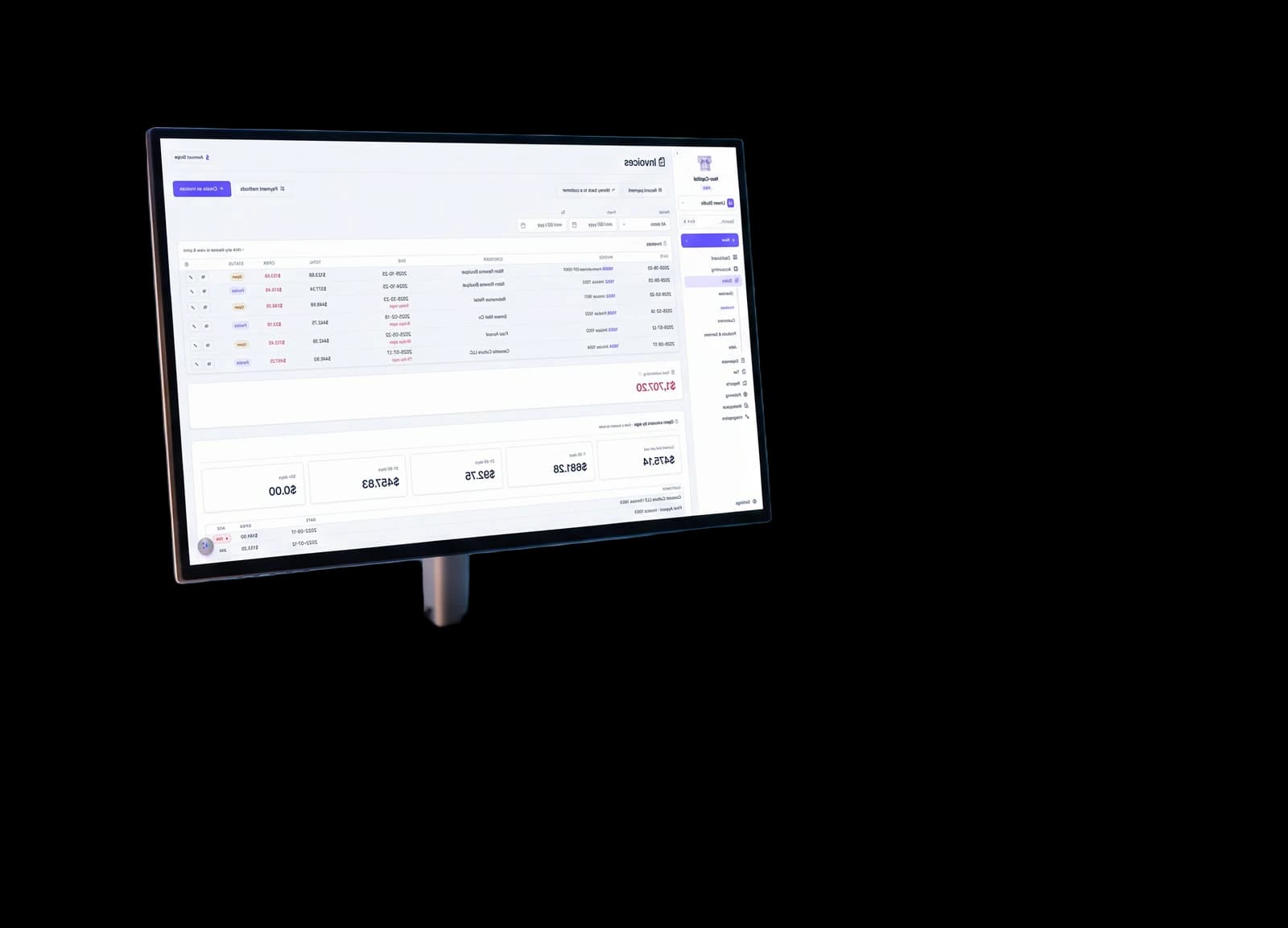
Serious accounting, in your browser
The full Neo-Capital platform, open the moment you sign in: bank feeds we pay for, invoices that collect their own payment, every statement your accountant asks for, the mobile app, and your team in the books with roles. Powerful enough for a practice, plain enough that you don't need one.
14 days free, no card · Nothing to install · Cancel any time and keep your books
Every page does one job, well.
The full accounting suite in a browser: ledger, A/R and A/P, bank reconciliation, and every financial statement.


Everything the books need, in one place
Not a lightweight web ledger with an upgrade path to the real thing. This is the real thing.
Bank feeds that behave
Connect your accounts and transactions arrive already categorized. Correct one and the rule sticks, retroactively, across everything that matches.
Invoicing and A/R
Branded invoices, estimates, sales orders, and an ageing report that tells you who's late before they tell you they're late.
Get paid on the invoice
Take card payment directly on any invoice you send. The payment reconciles itself into the ledger: no re-keying, no matching exercise later.
A ledger that ties
General ledger, journal entries, an editable chart of accounts, and a trial balance that balances as of any date you ask for.
Every statement
P&L, balance sheet, cash flow, A/R and A/P ageing, Schedule C. Cash or accrual, any period, exportable the way your accountant wants them.
Tax handled as you go
Deductions flagged when they happen, quarterly estimates kept current, 1099 contractors tracked, and sales-tax nexus watched across 51 jurisdictions.
Your accountant, in the books
Invite your bookkeeper or CPA into the same live file, with roles deciding who can post and who can only read. No more emailing versions around.
More than one business
Run several sets of books under one subscription and switch between them in a click, each completely separate from the others.
The mobile app, included
Dashboard, expense capture, and mileage from your phone, on every plan. The day's spending is in the books before you're home.
From nothing to real books, this afternoon
No implementation project, no consultant, no chart of accounts to design before you can record a single sale.
Sign in and you're in
No download, no licence key, no setup call. Your books open in whatever browser you happen to be sitting at: your laptop, the office desktop, a tablet on the train.
Bring your money in
Connect your bank and cards and let transactions flow in on their own, or drag in CSV and PDF statements. Moving from QuickBooks? Bring the whole file across, history intact.
It sorts itself out
Transactions arrive already categorized. Correct one and it remembers: the rule applies to every similar transaction from then on, including the ones already imported.
Read your business
P&L, cash flow, balance sheet, and a running estimate of what you'll owe in tax. Deductions you'd have missed get flagged as they appear, not next April.
Bring in your people
Invite a bookkeeper, an accountant, or your team into the same books, with roles that decide who can post entries and who can only look.
Drop in a CSV. Watch your books appear.
This is what the import flow looks like: categorization, deduction flagging, instant P&L. Running in a browser tab, on whatever machine you're at.
Your books, wherever the work happens
Included with every Neo-Capital Online plan (and with Desktop when Connected is on). Everything you log lands in the same books you open at your desk.
The dashboard, pocket-sized
Cash, profit, what's owed and what's due, with your cash flow drawn as a live picture. The glance that used to wait for your desk.
Capture it as it happens
Log an expense in the checkout line or a sale on the job. Ten seconds on the phone beats a shoebox of receipts on the 30th.
Mileage that becomes money
Track a trip with a tap and it lands in the mileage log, priced at the IRS rate, ready for the deduction it earns you.
Works where signal doesn't
Entries queue offline and sync themselves when you're back in range. A basement job site is not an excuse the books accept.
Locked to your face
The app sits behind Face ID or your fingerprint, so a lost phone is an inconvenience and not a disclosure.
Nothing to install, really
It runs from the browser and pins to your home screen like any app. No app store, no updates to chase, always current.
Your books send the mail and chase the money
Up to 2,000 emails a month, included in the plan: invoices with a pay button in them, reminders that chase the late ones on a schedule you set, and a record of every send against the document it came from.
Email the invoice, with a way to pay it
Press Email on any invoice and it goes to the customer on file: the whole document, itemized, with a Pay this invoice button when you've linked a processor. They pay by card on a page in your business's name, and the payment reconciles itself into your books. No PDF to attach, no portal for them to sign into.
Reminders on a cadence you set
A reminder rule is one number: days from the due date. Three before, on the day, a week late, a month late. Add, remove or reword them, cap how many any one invoice may ever get (5 out of the box), and leave it running. It's off until you turn it on, it stops the moment an invoice is paid or voided, and it physically cannot send the same reminder twice.
It looks like you, and replies come to you
Mail goes out under your business name with your address as the reply-to, so a customer hitting Reply reaches you, not us. Every send is logged against the document it came from, so you can always see what left, when, and whether it bounced.
| Brand identity, phase 2 | $3,200.00 |
| Motion package (6 assets) | $1,450.00 |
Questions? Just reply to this email. It comes straight back to us.
Sent by Lumen Studio via Neo-Capital.
- A reminder, 3 days before it's due
- A reminder, the day it's due
- A reminder, a week late
- A reminder, two weeks late
- A reminder, a month late
The default cadence. Change it, shorten it, or turn the whole thing off. It stops on its own the moment the invoice is paid.
The two things that usually cost extra
Time tracking and receipt capture are separate subscriptions almost everywhere else: a timesheet app, then a document-scraping app, then a monthly bill for gluing them to your books. Both are in here, wired to the ledger rather than syncing toward it.
A week of hours on one grid
Log time against an employee or a contractor, day by day across a weekly timesheet, or as single entries with a note. Mark an hour billable or not; the bill rate and cost rate are stamped onto the row as you enter it, so an hour invoiced in March still reads at March's rate after the rate changes in April.
Hours become an invoice
Pick a job or a customer and bill the unbilled work (hours, job costs, or both) onto one invoice, with a markup if you want one. Everything it billed is stamped so it stops appearing on the unbilled list, which is what makes double-billing an hour impossible rather than merely unlikely.
Jobs, and the mileage against them
Tag time, expenses and mileage to a job and read profit per project: the Smith remodel, the Acme retainer. Mileage carries its own deduction into the tax figures without being re-keyed anywhere.
It reads the receipt three ways
First the PDF's own text layer: free, instant, exact. Then a local OCR engine over the pixels, which costs nothing, needs no account and handles the photographed till receipt. Only if both come back blank does a vision model get a look, and only on a key you chose to add.
Then it turns into a transaction
Vendor, date, due date, amount and document number come back filled in. Match it to a transaction that's already in the books, or create the transaction from it. Either way the file becomes that transaction's attachment, so the number and its evidence never get separated again.
And the rest of the paperwork has a home
A searchable gallery of every receipt, and a separate store for tax returns, formation documents and anything else up to 50 MB a file. Filed by year, findable by name, attached where it belongs.
An hour is not a transaction until somebody bills it, so logged time never touches the ledger on its own. Once an hour is on an invoice a customer has received, editing it is refused rather than allowed to silently contradict the document it was billed on. Void the invoice and the hours are yours again.
One account. Every set of books you touch.
A workspace is one business's books and the people allowed near them. You get your own, you're handed one whenever somebody invites you into theirs, and you move between them from a list. No second login, no second password, no exporting anything to anybody.
A workspace is a set of books
Its own chart of accounts, its own customers, its own ledger and its own history, completely separate from every other one. Nothing bleeds between them, at tax time or ever.
Invite by email address
Type an address, pick a role, done. If they've never heard of Neo-Capital, the invitation waits for them and attaches itself the moment they sign up, so you can invite your accountant before they have an account.
Switch in a click
Your own books, your partner's, three clients': all in one list. Choosing one closes what's open, saves it, and reopens on the other. Two people can be in the same workspace at once.
Encrypted per workspace
Each workspace has its own key, wrapped individually to every member. Adding someone hands them a key; removing them takes it back. Our servers hold the ciphertext and never the key.
Five roles, and exactly what each one may do
Set per person, per workspace, changeable whenever. Your bookkeeper can post and close; your site crew can log hours and photograph receipts and see nothing else worth seeing.
| Can they… | Owner You, and anyone you make a co-owner | Accountant Your CPA or bookkeeper | Staff Bills, invoices, day-to-day entry | Field Crew on site: hours and receipts | Viewer A partner or lender who only looks |
|---|---|---|---|---|---|
See the books and reports Every statement, every register, every document. | |||||
Enter time, mileage, expenses, receipts The field entry a crew does from a phone. | |||||
Post transactions, invoices and bills The ordinary day's bookkeeping. | |||||
Export and build the accountant package CSV, accountant CSV, PDF, the one-click close ZIP. | |||||
Edit the chart of accounts, customers, vendors The master data everything else points at. | |||||
Close and lock a period Month and year close, and reopening one. | |||||
Change business settings and tax config Entity type, filing details, sales tax. | |||||
Invite, remove and re-role people Owner only, and it's enforced on the server, not just hidden in the UI. |
Two rules are enforced by the server rather than by hiding a button: a Viewer's changes are rejected outright, and only an owner can manage members. The account that created a workspace can never be demoted or removed from it, not by a co-owner, and not by accident.
Give a client the numbers, not the keys
Publish a read-only financial dashboard your client opens in a browser. No login to create, no software to install, and nothing they can change. You pick what appears on it, business by business.
Tick what they get to see
Stored per set of books, so two clients of the same practice can be shown completely different things.
- Headline figuresRevenue, net profit, expenses, cash on hand and A/R for the month.
- Six-month trendRevenue and net profit, month by month.
- Top expensesThe biggest expense categories for the period.
- Cash flowOperating, investing and financing, and the net change in cash.
- Your note to the clientThe message you write when you publish.
- Where the money wentThe P&L as a Sankey flow: every revenue source across to every cost and the bottom line.
- Profit & loss summaryRevenue, cost of sales, gross profit, expenses and net income.
- Who owes you (A/R aging)Outstanding invoices by how overdue they are. Some clients shouldn't see this; most should.
- Balance sheet summaryTotal assets, liabilities and equity as of today.
Filled boxes are on before you touch anything.
A link, and a passcode if you want one
Publishing gives you a URL to send. Add a passcode and the page asks for it first. Re-publish whenever the numbers move on. The link stays the same.
Only derived figures leave the books
Totals, KPIs and a monthly trend, computed in the app and published as a snapshot. Raw transactions never go, so a shared dashboard can't become a leaked ledger.
Email it, with the numbers in the message
One click mails the client their link along with a readable digest of the same figures, built from the same source, so the summary in their inbox can't disagree with the page behind it.
Read-only, permanently
There is no edit affordance to find and nothing on the page posts anywhere. It answers 'where do I stand' without ever becoming another person with access to your ledger.
The money arrives already broken out
Connect the places your money actually moves through, and a payout stops being one mysterious deposit. Gross sales, sales tax and the processor's fee land in three different accounts, the way your accountant needs them.
Plaid
Link your bank in a couple of clicks. Around 10,000 US institutions.
- You sign in at your bank's own screen, inside Plaid's window. Neo-Capital never sees the password and no banking credential is stored here.
- Each account links to one of yours with a start date, so switching a feed on over statements you already imported can't duplicate the overlap.
- Transactions arrive every few hours into review. Nothing posts to the ledger until you've looked at it.
- Plaid bills per linked bank per month. On Online that bill is ours, not yours.
Shopify
Payouts split into sales, tax and fees, automatically.
- Every payout arrives decomposed: gross sales to revenue, sales tax to the liability you owe, the processor's fee to a deductible expense.
- The net deposit is matched against the one your bank shows, so the money is counted once instead of twice.
- This is the job people pay Synder and A2X $50–100 a month to do.
Stripe
Charges, refunds and fees, as three lines instead of one.
- A payout is not revenue: it is revenue minus fees minus refunds. Neo-Capital books all three, so your P&L shows what you actually sold.
- A restricted, read-only key is all it takes, and you can revoke it from your Stripe dashboard at any moment.
Square
Card, cash and gift-card takings, told apart properly.
- Same decomposition as Stripe, with the tender types kept separate. Cash in the drawer is not a card settlement and shouldn't land in the same account.
- Processing fees post to their own expense account, where your accountant expects to find them.
PayPal
Three years of history, with the fee on every line.
- PayPal's API will hand back three years of transactions, so a mid-year switch doesn't leave a hole behind it.
- Every line carries its fee, which is the number that quietly disappears when a PayPal balance is reconciled by hand.
Gusto
Payroll posted as one journal entry, mapped to your own accounts.
- Gusto's own General Ledger Mapper is free and does the mapping on their side, against a chart of accounts you upload once, so payroll arrives coded by you, not guessed at by us.
- Wages, employer taxes, benefits, deductions and net pay all come through, and can split by job, department or project. Contractor payments export the same way.
- Debits must equal credits to the cent and every account must resolve. If either fails, the import refuses and posts nothing.
SimpleFIN
A second bank route, bought direct for about $15 a year.
- Some banks sit on SimpleFIN's bridge and not on Plaid, and some people would simply rather own the connection themselves.
- A book can run both. Use whichever reaches your bank.
Claude · OpenAI · Gemini
Optional: one key, for reading the dimmest receipts.
- Document reading tries the PDF's own text layer first, then a local OCR engine that costs nothing and needs no account. A model is the third rung, and only for what the first two couldn't read.
- Online you don't need a key at all to ask questions of your books. Your own Claude or ChatGPT connects to Neo-Capital instead.
Reading a processor and getting paid through one are two different things
The cards above read money that has already moved: your Stripe, Square or PayPal history, decomposed and booked. Getting paid is the other direction: link your own Stripe account and every invoice you send carries a Pay this invoice button, with the money landing in your account and the payment reconciling itself into your books. Same brand on the logo, opposite job.
Everything in Pro.
A complete accounting system, top to bottom: every primitive a CPA expects.
The general ledger
- Editable chart of accounts, grouped and auto-numbered by type
- Manual journal entries that only post when debits equal credits
- Full general ledger: every account's running register
- Trial balance that always ties, as of any date
- Recurring entries on a schedule (rent, amortization, accruals)
- Classes to track by department, location, or project
- Entries are never deleted: corrections reverse, history stays intact
Sales & accounts receivable
- Customers list with contact details and live balances
- Estimates → Sales Orders → Invoices: quote, confirm, then bill
- Branded invoice PDFs with your logo, or clean, unbranded workpaper PDFs
- A/R aging bucketed by age, with per-invoice detail
- Record payments applied oldest-first or to a specific invoice
- Open-invoice tracking and per-customer statements to send
Expenses & accounts payable
- Vendors & contractors, with W-9 / 1099 status
- Purchase orders: order, then receive against the PO
- Enter bills to A/P, then pay them to clear the balance
- A/P aging and an unpaid-bills list
- 1099 Summary: contractor totals ready for 1099-NEC filing
Items & inventory
- Products & services with a sales price and income account
- Inventory with quantity on hand and weighted-average cost
- Sales post COGS and reduce inventory automatically
- Reorder points, preferred vendors, and assemblies from a BOM
- Inventory report: stock status and item profitability
Reconciliation & period close
- Reconcile bank and credit-card accounts to the statement
- Lock a closed period so nothing on or before it can change
- Year close with Retained Earnings computed on the fly
- Reopen a period when you genuinely need to
- Clean Up This Book: a 30-task checklist for a file somebody else kept
Statements & exports
- Income Statement, Balance Sheet, Trial Balance (cash or accrual)
- A/R & A/P aging, Sales by Customer / Item, Vendor Concentration
- Cash Flow, Year-over-Year, Inventory, Forecast
- Export any report as CSV, Accountant CSV, PDF, or print
- Branded or plain workpaper styling, set once for every export
- One-click close package (ZIP) with every statement + the full GL
Migration & round-trip
- QuickBooks Desktop migration: accounts, customers, vendors, items, journal
- A/R & A/P subledgers reconstructed and reconciled against your source
- Atomic & fail-closed: safety backup first, rolls back if anything fails
- Import customer / vendor / item lists from CSV
- Accountant-format exports that re-import into other software
Sending, reminders & getting paid
- Email an invoice to its customer: itemized, in the body, from your business name
- Replies go to your address, not ours; every send logged against its document
- A Pay this invoice button when you've linked a card processor
- Card payments reconcile themselves back into the ledger, fee and all
- Payment reminders on a cadence you set, in days from the due date
- Reminders stop on payment or void, and can never send the same one twice
- Recurring invoices: memorize a document and let the schedule bill it
Connections & bank feeds
- Bank and credit-card feeds: roughly 12,000 US institutions, into review
- Shopify payouts decomposed into sales, tax and fees, matched to the deposit
- Stripe, Square and PayPal read as charges, refunds and fees, not one net line
- Gusto payroll imported as one journal entry, mapped to your own accounts
- CSV and PDF statement import for anything not on a feed
- Nothing posts unreviewed: a feed fills the review queue, not the ledger
Time, jobs & mileage
- Weekly timesheet grid, or single entries, for employees and contractors
- Billable / non-billable, with bill and cost rates stamped onto each hour
- Bill a job's unbilled time and costs onto one invoice, with optional markup
- Billed hours lock, so an invoice can't disagree with the record behind it
- Jobs and projects with revenue, cost and profit per job
- Mileage logged with its deduction carried into the tax figures
Receipts & documents
- Drop in a photo or PDF; vendor, date, amount and number come back filled in
- Read by the PDF's text layer, then local OCR: free, offline, no key needed
- A vision model only as a third attempt, and only on a key you added
- Match to an existing transaction, or create the transaction from the document
- The file becomes that transaction's attachment: number and evidence together
- A searchable receipt gallery, plus tax & legal document storage to 50 MB a file
Tax, deductions & 1099
- Deductions flagged as they happen, with inconsistencies surfaced for review
- Quarterly estimated tax kept current instead of computed in April
- Schedule C mapped from your own accounts
- 1099-NEC contractor totals, from payments actually linked to a contractor
- Sales-tax nexus watched across all 51 US jurisdictions, with early warnings
- Sales-tax reconciliation against what you've collected and what you owe
Budgets, forecasting & planning
- Monthly budgets per category, with a Budget vs Actual report
- Cash-flow forecast with runway, break-even month and one-off future events
- Loans with amortization, or recorded manually without a generated schedule
- Fixed assets capitalized and depreciated over their life
- Owner equity by entity type: LLC splits, capital stock, per-owner capital
Audit trail & integrity
- Append-only audit trail of every posting, reversal, and void
- Each entry stamped with the actor and timestamp
- Hash chain + sealed checkpoint with an on-page integrity check
- Export the trail with its hashes for an independent re-check
As much AI as you want. None that you don't.
Neo-Capital doesn't wallpaper the interface with AI buttons. When you do reach for it, it goes deeper than the copilots in the big-name suites, and you choose who provides it: our subscription, or your own.
Neo-Capital AI, on tap
An optional add-on on your existing subscription: 200 credits for $19, 600 for $49, or 1,800 for $129 a month. No API key to find, no provider account to open. It knows its way around your ledger.
A top-up when you need one
Run out mid-month? A one-time Credit Pack adds 500 credits for $49. No plan change, no renewal, and packs never expire.
Or bring your own
Connect Claude, ChatGPT, or Gemini on the subscription you already pay for, and pay us nothing at all for it. Same questions, your choice of model.
Never in your way
No forced copilot in the corner, no sparkle buttons on every field. The books behave like books, and the intelligence waits until you ask.
Your AI subscription powers the bookkeeping.
Neo-Capital exposes itself as a Model Context Protocol server. Add it as a connector in claude.ai, ChatGPT, or anything else that speaks MCP, approve it once, and ask questions of your books in the AI window you already pay for. No API key to buy, nothing to install.
We never proxy AI cycles. We never see your conversation. You use the AI subscription you already have, with no added fees from us.
claude.ai & ChatGPT
Add the connector address in your AI's settings. It calls in over HTTPS: no local process, no machine that has to be switched on.
You approve it once
Authorizing opens a consent screen inside Neo-Capital, where you're already signed in. There is no password prompt, because a page asking for one would be a phishing page.
Read-only, deliberately
38 tools that can read anything in your books and change nothing. The 11 that would write are withheld from the connector entirely. An outside AI answers questions here; it does not post entries.
Still zero-knowledge
A connector token identifies you and carries no key material. Serving your books needs your own live, unlocked session, so a stolen token, or a dump of the token store, decrypts nothing.
Pick a plan, change it whenever
Every plan is the same accounting engine, and every one starts with 14 days free, no card. Cancel any time and you keep your books.
Basic
Bookkeeping without the vocabulary
or $190/year (two months free)
Everything one business needs, in a browser. Connect your bank and the books keep themselves: sorted, deductions flagged, tax estimated as you go.
- Unlimited invoices & transactions
- Bank sync that learns your categories
- Deduction finder + quarterly tax estimates
- P&L, cash flow & Schedule C
Pro
The whole accountant's cockpit
or $390/year (two months free)
The ledger out in the open (journal entries, A/P, reconciliation and period close), wrapped in bank feeds, invoices that email themselves with a pay button, time tracking and receipt capture, with three people on one subscription and more business books whenever you need them.
- 1 business book · 3 users with roles
- Add business books anytime, $9/month each
- General ledger, A/P & bank reconciliation
- Bank feeds + Shopify, Stripe, Square, PayPal
- Invoice emails with a pay link, 2,000/month
- Time tracking, receipt reading & every statement
- QuickBooks migration + audit trail
Firm
Your whole client roster
or $990/year (two months free)
Unlimited client books and unlimited people, with every Pro capability on every one of them, plus a dashboard you can publish to each client.
- Unlimited client books · unlimited users
- Add more files any time at $9/month each
- Publishable client dashboards
- Everything in Online Pro
Every plan includes a personal book alongside the business books. Pro can add business books for $9/month each. Hit ten and you move to Firm automatically, which costs less than the tenth file would have.
Decide to own it later? Your rate drops.
One account runs both products. Buy Neo-Capital Desktop at any point and your subscription becomes Connected, the owner's rate for the same cloud: $15/month on Basic, $22 on Pro, $35 on Firm. Same books, same browser, same phone. You just stop paying for software you now own.
See Neo-Capital DesktopCancel and keep your books
If you leave, we hand you a full export and a free Neo-Capital Desktop Basic licence, so you can keep opening your own books on your own machine, forever, for nothing.
Your accounting history should not be something you rent.
Your financials, stored so we can't read them
Your books are held as ciphertext, encrypted under a key derived in your browser from a password we never receive. Sign out and what remains on our side is unreadable to us. If you forget the password, a one-time recovery code you saved at signup gets you back in. We can't do it for you, which is rather the point.
The honest caveat: while you're signed in and working, the engine has to hold your key in memory to compute anything at all. So this is zero-knowledge at rest, not end-to-end in every instant. If you want the version where no key ever touches our infrastructure, that's Desktop with Connected sync.
Where the pricing sits
If you're weighing this against what you're paying now: Online Pro is $39/month, and it isn't an introductory rate that steps up later.
| Neo-Capital Online | QuickBooks Online | Xero | |
|---|---|---|---|
| Entry plan, per month | $19 | $38 | $25 |
| Small-business plan, per month | $39 | $75 | $55 |
| Practice / top plan, per month | $99 | $275 | $90 |
| Unlimited invoices on the entry plan | |||
| Unlimited bills on the entry plan | |||
| Multiple businesses on one subscription | 3–10+ | ||
| Books encrypted so the vendor can't read them | |||
| A desktop version you can buy outright | |||
| Keep working in your books after you cancel |
Competitor pricing is US list as published in July 2026 and excludes introductory discounts. Xero's entry plan caps invoices and bills per month; ours doesn't.
The things people actually ask
How does the free trial work?
Every plan starts with 14 days free and no card. You get the whole plan, not a crippled demo: connect a bank, import your history, invoice someone, run the reports. If you don't subscribe at the end, nothing is charged and your books are still yours to export.
Is this real accounting, or a simplified web app?
Real, and it's the same engine our desktop app runs, not a reduced web build. Every transaction posts a balanced journal entry, the trial balance always ties, and entries are never destroyed: corrections reverse and the history stays intact. An accountant can work in it without translating anything.
What if I don't know accounting?
Then you never have to see it. Basic keeps the ledger under the hood and shows you plain-English views: what came in, what went out, what you can deduct, what you'll owe. The real books are being kept correctly the whole time, ready for the day you or your accountant want them.
Can I move over from QuickBooks?
Yes: accounts, customers, vendors, and transaction history come across, so you're not starting from an empty file in the middle of a tax year. Bank and card statements import from CSV or PDF too.
Which reports do I get?
Profit & loss, balance sheet, cash flow, trial balance, general ledger, A/R and A/P ageing, and Schedule C, on cash or accrual, as of any date. Plus 1099 contractor tracking and sales-tax nexus across 51 jurisdictions.
Can my accountant get in?
On Pro and Firm, yes: invite them into the same books with a role that fits, whether that's full posting rights or view-only. No exporting files back and forth, no 'which version is current'.
Do you use my data to train anything, or sell it?
No. We also can't: your books are stored encrypted under a key derived from your password, so once you sign out they're unreadable to us. There's more detail on exactly how that works, and where its limits are, further down this page.
What happens if I cancel?
You get a full export of your books plus a free Neo-Capital Desktop Basic licence, so you can keep opening them on your own machine forever. We'd rather earn a renewal than hold your accounts hostage.
Can I switch plans later?
Any time, in either direction. Add a business file to Basic or Pro whenever you need one; hit ten files and you move to Firm automatically, which costs less than the tenth file would have on Pro.
Open a browser. Start keeping books.
Free for 14 days, no card. Nothing to install, nothing to configure before you can record your first sale.